
Why Backlinks Are More Important (And Expensive) Than Ever in 2026
If you run a business with a website, you have likely heard the phrase “Content is King.” While that remains true, the crown is heavy, and it requires a strong foundation to hold it up.
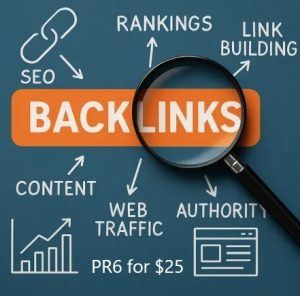
That foundation is backlinks.
For years, SEO experts have debated whether links are losing their power. With the rise of AI Overviews, zero-click searches, and complex algorithm updates, some speculated that Google might rely less on “votes” from other sites.
The data for 2026 tells a very different story. Not only are backlinks still the backbone of organic ranking, but acquiring high-quality links is now more critical—and significantly more expensive—than it has ever been.
Here is why your business needs to prioritize link building immediately, and what you should expect to pay for the privilege of ranking on page one on search engines and more importantly now getting your business website mentioned in the A.I. mentions at the top of the search page!
The 2026 Reality: Links Are the Ultimate Trust Signal
Despite the hype around AI, Google’s core product is still trust. The internet is flooded with AI-generated content. Anyone with a $20 subscription can produce 1,000 blog posts a day. So, how does Google differentiate between a legitimate business and a spam site?
They look at who is vouching for you.
According to recent data, there is a clear correlation (r=0.38) between the number of referring domains pointing to a page and its ranking position—this remains the strongest correlation of all examined ranking factors . In raw numbers, the average result ranking in Position 1 has 168 referring domains. Position 2 has 128, and Position 3 drops to 97 .
The gap between first and tenth place is no longer just about having a keyword in your title; it is a moat built by backlinks. If you aren’t actively building links, a competitor with a higher domain authority (DA) will outrank you every time, even if their content is slightly worse than yours.
The “Cost of Entry” Is Rising
Here is the problem every business faces in 2026: Supply and demand.
High-quality, authoritative websites (like industry news hubs or .edu resources) have a finite amount of “link equity” to give out. As more businesses realize they need these links to survive the AI content flood, the price for access has skyrocketed.
Publisher placement fees have increased 20–40% over the past two years, primarily due to the demand for quality content and limited editorial inventory . Furthermore, the average cost per link is rising by 15-20% annually due to increasing competition .
Waiting six months to start a link-building campaign doesn’t just mean you are losing potential traffic; it means the same link you want today will likely cost you 10% more next quarter.
The Price Tag of Authority (Cost Comparison)
When we talk about “good sites,” we often measure them by Domain Rating (DR) or Domain Authority (DA). This is a score (usually out of 100) that predicts how well a site will rank.
The price of a backlink is almost directly exponential to this score. A link from a DR 20 blog might cost you a cup of coffee (figuratively), but a link from a DR 80+ publication is a significant capital investment.
How the Internet measures website Authority
PageRank (PR): Google’s original algorithm, scored on a scale from 0 to 10. A PR6 indicated a highly established, authoritative page.
Domain Rating (DR): An SEO metric by Ahrefs, scored from 0 to 100, which evaluates the relative strength of a website’s total backlink profile
To help you visualize the market rates for 2026, here is a breakdown of what you can expect to pay per link based on the authority of the linking site:
Currently we are only asking $25 for a back link!!
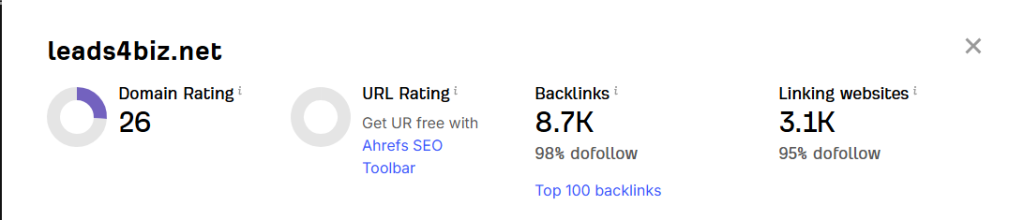
Analysis of the Data: Notice the steep jump between DR 60 and DR 80. A “good” link used to be considered DR 50. In 2026, to truly move the needle in a competitive space (like SaaS, Finance, or eCommerce), you need DR 60+ links, which consistently cost $500 to 1,500+ .
Beyond Ranking: The AI Overviews Factor
Why are prices exploding at the top end? Because of AI.
Google’s AI Overviews (and other LLMs like Perplexity) rely heavily on “trusted” sources. Studies show that AI Overviews now reduce the Click-Through Rate (CTR) for the #1 organic result by 58% . However, the brands that win in this environment are the ones cited inside the AI answer block.
How do you get cited by AI? You need links from the high-authority, “trusted” publications that the AI was trained on. As one industry expert noted, “Getting cited inside the AI Overview itself is increasingly the prize, and those citations almost always come from coverage on publications AI models trust” . This has created a surge in demand for premium Digital PR (starting at $2,750+ per month for campaigns), driving prices up further .
Agency vs. Freelance vs. In-House
You have three options for acquiring these links, and the costs vary dramatically:
- Basic/Freelance Services (1,500–1,500–5,000/mo): You get 5-10 links per month from DR 20-40 sites. Good for new websites .
- Professional Agencies (5,000–5,000–12,000/mo): You get 10-20 links per month from DR 40-60 sites. This is the “workhorse” tier for serious SEO .
- Premium/Digital PR (12,000–12,000–25,000+/mo): You get 15-30+ links from DR 60-90 sites. This includes original data studies and journalist outreach .
- In-House Builder (4,500–4,500–8,000/mo salary): This is just the cost of the employee, excluding the tools and outreach budget needed to actually secure the links .
The Verdict: You Can’t Afford to Wait
The days of cheap, easy links are over. With 96.6% of content getting zero external backlinks, simply publishing a blog post is a waste of time if you don’t have a promotional strategy .
Ignoring backlinks in 2026 is effectively choosing to be invisible. As the algorithms get smarter and AI content floods the market, the only thing left to separate the professionals from the amateurs is Authority.
If you sell online or rely on your website for leads, your budget must allocate funds for link acquisition. The costs are going up, the competition is getting smarter, and the window to secure those high-DR placements is shrinking every day.
The best time to start building links was five years ago. The second-best time is now—before the prices rise again next quarter.
*This post uses current market data from 2025-2026 industry surveys, including Ahrefs, Moz, and Authority Hacker, to provide accurate pricing benchmarks for businesses looking to scale their organic presence.*